WHY MARKETS FORGIVE CEO'S THEY CANNOT REPLACE.

Jensen..Jensen..Jensen!
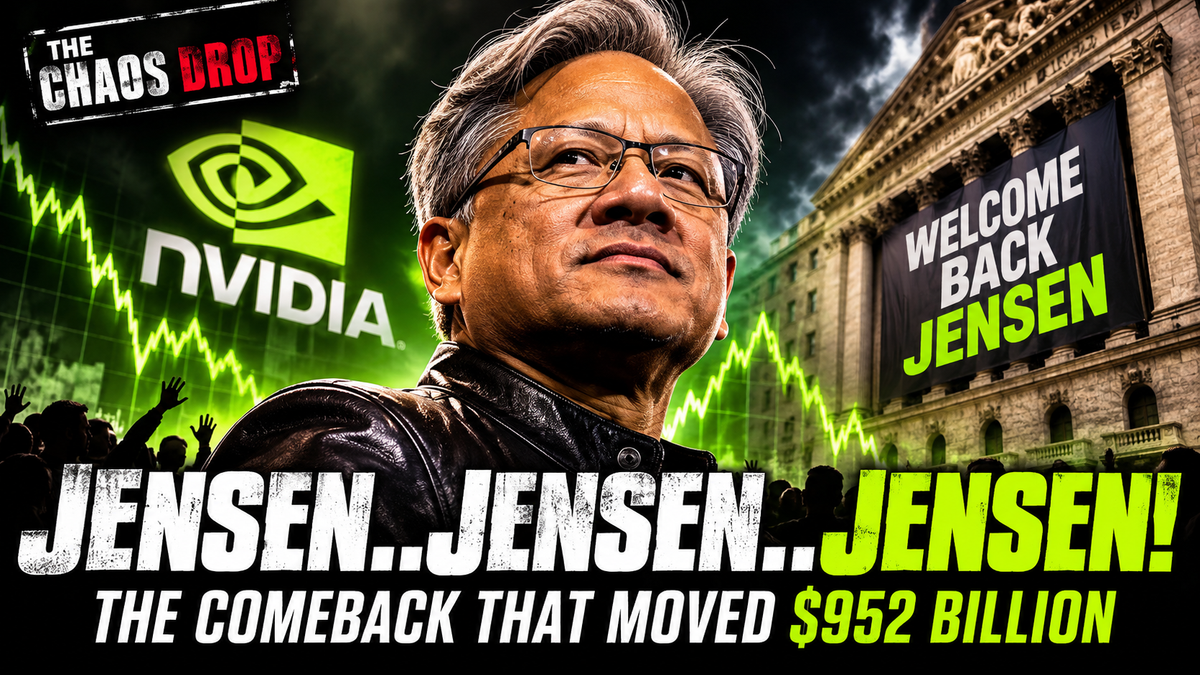
You've heard the echo worldwide. Jensen Huang is back as CEO of Nvidia. The board accepted his resignation, its chairman told investors six days later that he would not be rehired, and on November 23 the board unanimously reinstated him. What a change of heart, particularly when you consider what happened to the share price in between.
On November 17, chair Harvey Jones told investors that Jensen Huang would not be returning. On November 23, the board unanimously reinstated him, effective immediately. Six days from rejection to reinstatement. Almost looks like they wanted to beat every prediction market. I've seen enough weird in the Culture Markets, but this blew me away.
The release adds that the board took input from "senior levels of the United States government" before concluding he poses no national security risk.
My thesis is that the market does not forget or forgive. I truly and firmly believe the market has no morals. It may have a discount rate though. What looks like forgiveness is just a price, a number on what the person is worth to the cash engine overall, minus what it costs to replace them, minus the legal tail. So, Jensen cleared that math. Welcome to The Chaos Drop. I have been writing since this broke the internet, and here's hoping forgiveness remains the theme for this Christmas.
Previously on Nvidia.
The short version, for the people who need to get back to checking their wallets on Polymarket or Kalshi because clearly, the board even smashed that run.
Oct 29. Reports link Jensen Huang to Alice Huang, a Chinese citizen and former executive at Megaspeed, a Singapore based firm that leases AI compute and became a significant Nvidia customer. US officials were concerned she may have been acting on behalf of Chinese intelligence. The evidence has not been made public, and the investigation remains ongoing. Megaspeed denies wrongdoing and says its business is legitimate. So far so good?
Days earlier. Jensen told Bloomberg that his interactions with the Megaspeed executive were completely normal, tied to the company's business.
Nov 8. He admits an affair in a message to employees, without naming anyone. Nvidia's board launches an independent investigation into reports that he may have been targeted by a foreign intelligence operation.
Nov 9. Nvidia shares fall about 4.3%, erasing roughly $192B of market value.
Nov 11. The New York Times, citing five people who worked at Nvidia, reports a second alleged affair, with Kimberly Powell, an Nvidia vice president who reported directly to Jensen. The board meets to discuss his future.
Nov 12. Jensen resigns. CFO Colette Kress becomes interim CEO and Harvey Jones becomes the company's first ever chair. Just hours later, Reuters reports another alleged relationship, with an Nvidia employee.
Nov 15-16. The scene now unfolds with FT reporting Jensen is considering a return. Elon Musk backs the campaign. President Trump says he would certainly not mind. And a petition gathers more than 180,000 signatures. Nope, nothing out of the ordinary.
Nov 17. Jensen posts that he would be honoured to return. The board chairman says no means no, on an earnings call, while Nvidia raises its outlook.
Nov 23. The board says yes. And then Jensen...Jensen...Jensen is back.
Let's look at the Tape.
Nvidia fell from $186.64 on Nov 6 to an intraday low of $150.33 on Nov 17, a drop of roughly 19.5%. Then a five sentence statement added roughly $90B of market value in ten minutes. That's more than the entire market cap of many listed companies, summed up by a statement shorter than most of my LinkedIn posts.
Nov 6: Last close before the board opened its review. $186.64.
Nov 9: Affair admitted, intelligence target investigation disclosed. Shares down about 4.3%, roughly $192B erased.
Nov 12: Resignation. Shares opened down as much as 14%, then clawed back. Closed at $166.19, down 4.3%.
Nov 13: Closed at $162.85, down 2%.
Nov 16: Trump says he would not mind a return. Board reportedly not considering it. Closed at $156.14, down about 4.1%.
Nov 17: Jensen says he would be honoured to return. Shares briefly rally, hitting an intraday low of $150.33 before recovering. Approximately $90B added in ten minutes following his statement.
Nov 17, after hours: Earnings beat, outlook raised, board rejects a return. Shares initially rise on results before the market reassesses the leadership news.
Nov 23: Board reinstates Jensen. Shares close at $165.05, up 31.48%. Approximately $952B added to market value.
I love the numbers here and two more of those explain the panic. Nvidia is more than 6% of the S&P 500, so its succession risk is a portfolio risk for millions of people who never asked to own it. And on Nov 16, roughly 40% of prediction market bettors thought he'd be back by next year. But the board delivered in a week. So i'm telling myself, Index Funds don't forgive but they look like hostages in this situation. Is that a tell? Nah, let's not get to conspiracy theories. Yet.
So, Who Showed Up
A comeback needs a powerful coalition, in our friends case he had a president, the world's richest man, a hedge fund billionaire and a sweet petition.
President Trump. On Nov 16 he said Jensen had learned a big lesson and that he would certainly not mind a return. Jensen has been a regular White House visitor, more than half a dozen times between January 2025 and October 2026, per ABC.
Elon Musk. He signed the petition and warned that Nvidia could lose major deals without his friend Jensen. His argument was that many important business arrangements depended on personal trust, a handshake with Jensen rather than a written contract. His companies are also part of the AI ecosystem that relies on Nvidia's chips. Well in most cases the customer is always right, and this one also tweets more when he is.
Bill Ackman. He urged the public to support Jensen and his family, arguing that even incredible humans make mistakes.
Sam Altman. He called Jensen a hero who has flaws and declined to endorse a return. The man who got himself unfired in five days, and still wouldn't sign.
The petition. Stand with Jensen passed 180,000 signatures, plus a reported Silicon Valley war room lobbying on his behalf.
Meanwhile, the board had hired Heidrick & Struggles and was reportedly talking to candidates including Arm CEO Rene Haas. Picture this, the board interviewing his replacement while 180,000 people petition for the founder. I want to buy rights just so I can screen write the reality show.
I do feel there is a footnote my grand coalition would prefer you skip. The New York Times reported that President Trump had been briefed in May 2026 on intelligence concerns about Alice Huang, roughly six months earlier, and that Jensen Huang later joined him on the China trip. In addition to reality tv rights I also want to say...Hello Democrats?
My Cash Engine Theory
Markets never care if someone is good. They ask whether the overall machine runs without them. It's a simple calculation, the cash flow lost if he leaves, minus the cost of replacing him, minus the legal and commercial liabilities he leaves behind. If the numbers work, he comes back. If they don't, he gets a book deal or the TV rights. Jensens case ticks all four boxes. He is the engine, the damage so far is not as substantial as it could be, he has a tribe of 180,000 supporters, and the worlds richest man along with Washington is gatekeeping for him.
When you run the numbers, it is uncomfortable but it turns out clean. Nvidia's moat was supposed to be CUDA. It turns out the moat is a 33 year old company, a 63 year old founder in a leather jacket, and a board that discovers its feelings on a six day cycle.
The Rogues Gallery
Income statements have backed several comebacks and in some cases ensured they stay away. My short list.
Steve Jobs
Left Apple in 1985 after a boardroom power struggle. Returned 12 years later.
Howard Schultz
Left Starbucks as CEO in June 2000, returned in January 2008. About 7.5 years.
Sam Altman
Fired by OpenAI's board in November 2023. Back in about five days. Employees and Microsoft made the board's position untenable.
Mark Hurd
Resigned from HP in 2010 over expense reports tied to a contractor relationship. About a month later, Oracle hired him almost immediately.
Elon Musk
Settled with the SEC in 2018 over his funding secured tweet, paid a fine and gave up the chair. No interruption as CEO. Tesla kept him.
Bill Clinton
Impeached in December 1998, acquitted in February 1999. Zero time out. Approval hit a presidency-high of 73% around the impeachment vote, with a strong economy and voters divided over the process.
Donald Trump
Convicted on 34 felony counts in New York in May 2024. Re-elected in November 2024. Supporters read the cases as political, and voters ranked other issues higher. Critics say the election tells you nothing about the merits of the cases.
Weinstein, Moonves, Kalanick
Ousted or convicted between 2017 and 2020. No return to their original top jobs. Replaceable, or the damage hit the business through settlements, partners walking and investors revolting.
The survivors share two traits, the machine is worth more than the affair, and the affair lands on someone other than the shareholders. The permanently gone share the reverse. Selection bias is doing a lot of work here. We remember the comebacks because they're a better story than the quiet LinkedIn posts from the ones who didn't. Have you seen a confetti led animation for a goodbye post vs the juicy choices on, " I am happy to share I have joined..." Nope.
Jensen is the first case in this group where the alleged sin is a national security question, not just a conduct one. That's what makes the board's six day reversal unusual. It's less a market forgiving a man than a company concluding its stock can't survive a rematch with his absence.
Dec 1: Prediction and Markets.
Jensen and Nvidia general counsel Tim Teter agreed to closed door transcribed interviews on Dec 1-2 with three House committees: Foreign Affairs, Intelligence, and the Select Committee on the CCP. Nothing here is going to be televised.
What follows is my read, and the odds are my estimates.
Base case, about 60%: anticlimax with leaks. Jensen says the contacts were commercial, nothing classified or proprietary moved, and Nvidia complied with export rules. Members emerge and describe the session along party lines. Democrats, who have already pushed for public testimony on China chip policy, say it wasn't enough. The stock trades on leaks and may be not so much on content.
Second case, about 30%: a slow drip. Questions focus less on the affair and more on Megaspeed, a major customer, and where Nvidia hardware ended up. Reports of chip diversion keep the story alive through December. The board leans on its new National Security and Export Control Oversight Committee as a shield.
Tail case, about 10%: a contradiction. A message, a calendar entry or a document that doesn't match what he told Bloomberg, his executives or the committees. A knowingly false material statement to Congress can be a crime even in a closed room interview. And the board has no clean exit, because it voted unanimously for him after saying it had received government input.
I would not watch the affair as much I would watch the paper trail around Megaspeed. The affair is a character question. The chips are a compliance question, and the second kind is the one Wall Street can't price away.
One last thing. The tidy lesson is that the market forgives great CEOs. The accurate lesson is that it forgives useful ones, until the day the usefulness is outweighed by the liability. Maybe Jensen just bought himself a month. December will tell us whether it was a pardon or a repayment plan.
Jensen Huang on The Chaos Drop
I follow the money, the power and the people moving culture markets. Sometimes that takes me to a stadium, sometimes a boardroom, and sometimes to a man with excellent taste in leather jackets. If this made you look at the markets a little differently, share it. It does help The Chaos Drop travel.