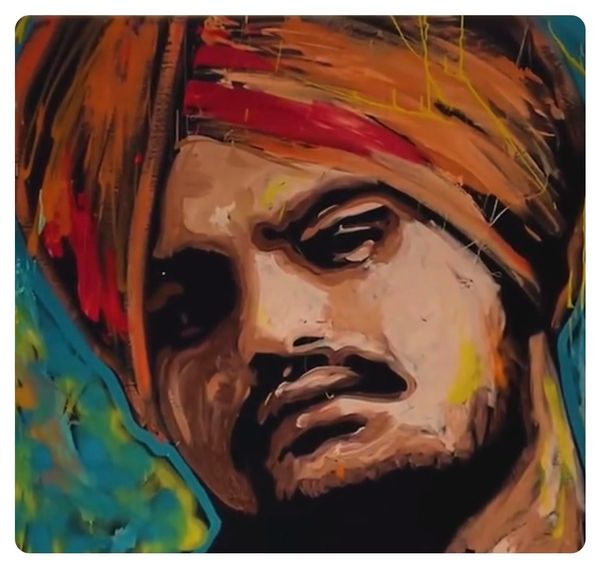
"If you stay on a Bull for 8 seconds and don't die, we'll give you a Million Dollars". Marc Lasry.


Marc Lasry sold his stake in the Milwaukee Bucks in 2023 and went looking for what comes next. His Avenue Sports Fund has now closed with more than $1 billion in commitments, targeting exactly the sports most traditional investors would have ignored, Sailing, Bull Riding, Indoor Golf, Women’s Basketball.
That tells you something. This is about a new generation of sports being built as media, entertainment and investment products. Why is large capital paying up front before a single play is booked?
I have been a fan of Red Bull and they understood this nearly 20 years ago. Don't just sponsor the sport. Build the content around it. Own the audience. Create the culture. Even today I can feel David Coulthard rev the engines in Mumbai as if it were yesterday.
Now private equity, sovereign capital and the world's biggest media companies are arriving at the same conclusion. As always, let's look at where the money is going.
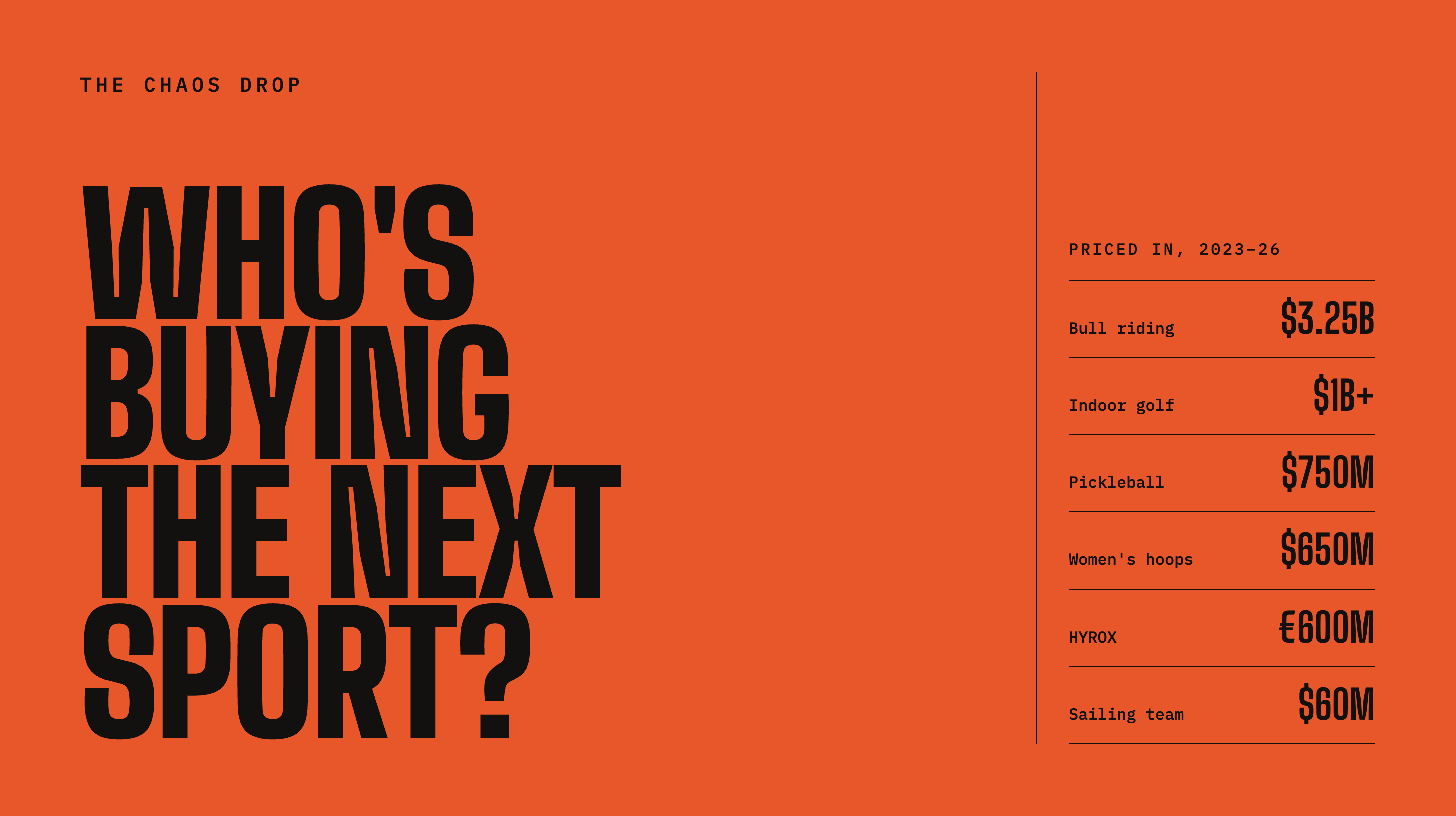
SailGP Teams are going for $60M
The SailGP valuation trajectory is the loudest proof concept yet that niche sports properties can command major league premium. In just three years, entry ticket prices have skyrocketed by roughly 400% to 800%! Teams that once traded hands for $5 million to $10 million are now commanding $45 million and above. This is a rapidly escalating secondary market driven by institutional capital and cross sport titans. Take Avenue Sports Fund’s $35 million acquisition of the US Team in late 2023, followed by a $45 million valuation for the Italian squad in 2025. By the time American Magic paid a reported $60 million to acquire the Danish entry in 2026, the floor had completely reset. For sports investors, SailGP has become a textbook case study in franchise inflation, proving that high production media rights, billionaire backed stability, and a globally scalable, premium ecosystem can rapidly convert a niche racing circuit into an elite asset class.
Bull Riding at $3.25B
For a simple Rodeo, there is some serious money riding on a bull. TKO bought Professional Bull Riders as part of a $3.25 billion acquisition of PBR, IMG and On Location and other assets from Endeavor. So no, the bull wasn't worth $3.25 billion. But TKO clearly believes the property belongs inside the same commercial universe as UFC and WWE. Avenue Sports Fund owns the New York Mavericks. Paramount+ now carries PBR. And the product is beautifully simple, stay on the bull for eight seconds. I heard Mark say it on a video on my gram feed, he goes "come to the US, sit on a Bull, if you don'd die and cross 8 secs, we'll give you a million". Feels like the pre rails for a great betting commercial.
Golf at $250B
Tiger Woods and Rory McIlroy built an indoor golf league that averaged only around half a million viewers a broadcast in its second season. Yet TMRW Sports is now reportedly being valued at more than $1 billion, double its valuation when it raised its Series A in 2024. Investors aren't paying $1 billion for today's audience but trust me when i say that they're paying for the possibility of golf's next audience. The total economic footprint of golf worldwide is estimated to exceed $250 billion. For context, the U.S. market alone commands a direct annual economic impact of $101.7 billion, swelling to a broader economic footprint of $226.5 billion once indirect spending, manufacturing, and supply chains are factored in. I could get into Golf Tourism and how many families travel to play Golf, your mind will be blown. For now let's stick to the capital.
Unrivaled valued at $650M
Women's basketball may be the cleanest example of capital moving ahead of television. Unrivaled has just raised more than $100 million at a $650 million valuation, nearly double its $340 million valuation a year earlier. More than 95% of its players reportedly now hold equity. That is interesting because the pitch isn't simply “watch women's basketball.” It is own the league, own the players, own the relationship with the audience. Any other sport giving out equity in the league to players?
Pickleball for $750M
The massive $225 million growth equity injection into Pickleball Inc. is a masterclass in sports asset roll ups. Led by Apollo Sports Capital and Tom Dundon, this deal values the consolidated entity at $750 million and establishes a vertically integrated powerhouse controlling everything from elite professional tours (MLP and PPA) to grassroots software (DUPR), court infrastructure, and retail. By unifying a highly fragmented landscape under a single corporate umbrella, the parent company has moved past the volatile "land-grab" phase of the pickleball craze and into a highly monetisable ecosystem. For sports tech and private equity investors, this $315 million total funding milestone signals that pickleball is no longer just a participation trend, but a mature, institutional grade asset class capable of driving predictable SaaS, media, and real estate revenues.
HYROX
The €600 million institutional takeover of HYROX is a definitive case study in how modern fitness brands can completely bypass the traditional sports media playbook. When the "World Series of Fitness Racing" debuted in Hamburg in 2017 with just 650 competitors, traditional sports investors would have written it off as a hyper-niche participatory event. Fast forward to the 2025–26 season, and that spark has ignited a massive global phenomenon drawing 1.4 million active participants worldwide. This staggering operational scale is precisely why L Catterton, the private equity powerhouse backed by luxury giant LVMH led a heavyweight consortium to buy control of the business from Infront at a reported €600 million valuation.
For the sports capital ecosystem, the HYROX ascent proves a profound counter-intuitive truth, you don’t need to spend millions buying broadcast airtime to manufacture a passive viewing audience from scratch. If you build a highly engaged, fiercely loyal tribe of active participants, the commercial monetization and the multi-million dollar private equity valuations will organically follow.
Premier Padel
Qatar Sports Investments completely rewrote the sports ownership playbook by launching Premier Padel and swiftly acquiring its chief rival, the World Padel Tour, to unify a highly fragmented professional sport under a single global umbrella. While the market cannot quote a neat billion dollar valuation just yet, the underlying strategy is far more lucrative than a standalone number. QSI chose to capture the entire sport's infrastructure before anyone else could slice up the market. This structural monopoly has turned Premier Padel into a commercial magnet, drawing institutional heavyweights like Red Bull and elite sponsors like Qatar Airways into its orbit.
And then there is Saudi Arabia with Combat Sports.
Zuffa Boxing is a joint venture between TKO and Sela, a Saudi entertainment conglomerate, led by Dana White and Turki Alalshikh, chairman of Saudi Arabia's General Entertainment Authority. Paramount had already committed $7.7 billion over seven years for UFC's United States rights, and Front Office Sports reports it signed Zuffa Boxing to a five year deal months before the first card on January 23, 2026, terms undisclosed. A media buyer priced a promotion with no events behind it on the strength of its founder's record!
If there is sports, there will be Betting.
Betting is the second layer of capital under these leagues, and rights holders underprice it. DraftKings became the only American operator offering SailGP odds in 2025, with bet365 covering international markets. FanDuel is TGL's official odds partner and runs odds inside the ESPN broadcast. FanDuel and the PPA Tour, working with Genius Sports, opened pickleball betting in 2023. Endeavor's OpenBet priced PBR that same year and DraftKings followed in 2024. Betsson signed a global Premier Padel deal. Lasry's own bull riding pitch is that people love betting on whether a rider lasts eight seconds. Zoom out. Pew counted roughly $53 billion of combined Kalshi and Polymarket volume in July, with sports the largest category.
The Chaos of Sports Capital.
The interesting shift is that capital is no longer asking only, How many people watch? It is asking, can I own the format? Can I control the franchise? Can I monetise the fan beyond the broadcast? Can I sell sponsorship, tickets, content and betting? Can I make the asset more valuable as the sport grows? Red Bull figured out years ago that packaging can create value where prestige doesn't exist yet. Private equity has now discovered the same thing. The next great sports league may not be the one with the biggest audience. It may be the one that figured out how to package a small audience into a very valuable business.
Swaroop Banerjee is a live entertainment & sports economy IP executive with over twenty years building sovereign scale IPs across South Asia, the GCC, and Australia. He is the author and founder of The Chaos Drop.
The Chaos Drop maps the Capital of Culture, where entertainment, fandom, and capital move as one. We follow the money.