Funny Business: Who's Making Money in Stand Up?

My favourite stand up is the President of the United States, and I mean that purely as a trade observation. Few people alive produce more quotable material. A line, a tweet, an insult or a walk back. Within minutes, his clip is everywhere, shared by people who love him or who think he is a walking punchline. He is viral, almost always.
The business of being funny is getting serious. And the numbers are not the joke. I have toured with some of the largest comics in the world, been called a rookie by Gabriel and reserved an empty front row for Royal VIPs who didn't turn up at all.
These fellas have seen it all, from scandals to supreme courts, from being cancelled to rewriting world records. At the end, I would think they had the last laugh.
The $837 Million LOL
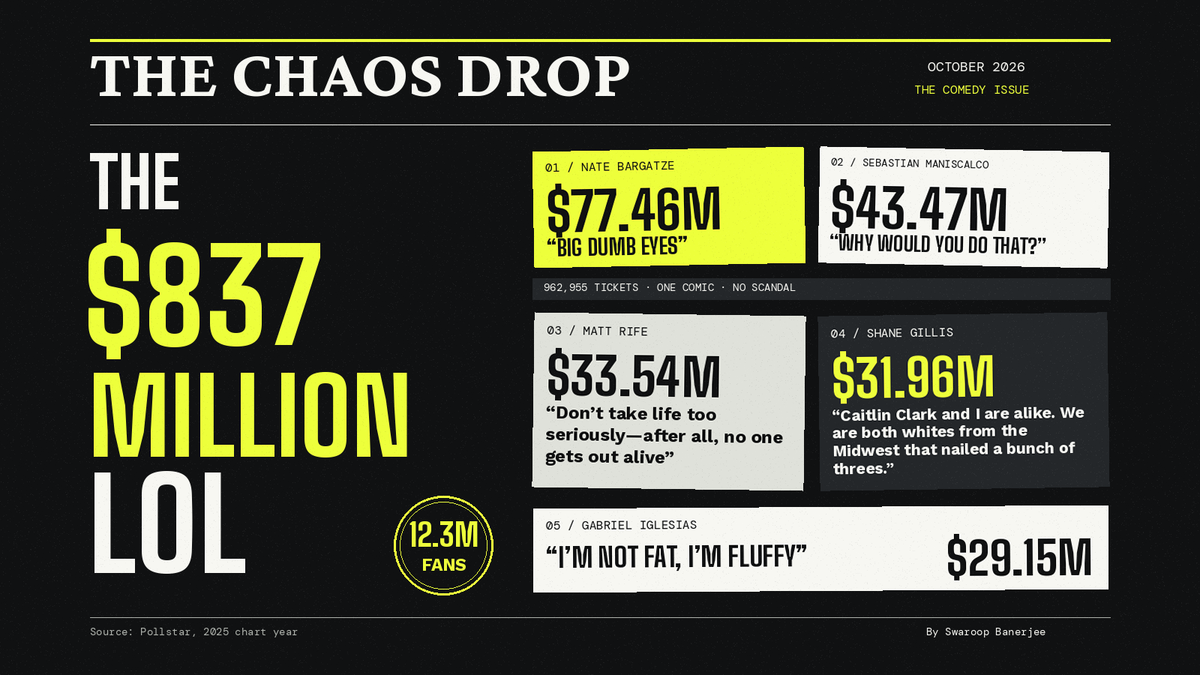
Pollstar, the live entertainment industry's box office tracker, counted $837 million in worldwide gross at events featuring comedy headliners during its 2025 chart year, across 12.3 million fans. Nate Bargatze alone accounted for $77.46 million. Sebastian Maniscalco made $43.47 million in reported tour gross, while Matt Rife, Shane Gillis and Gabriel Iglesias rounded out the top five.
The audience has grown, too. Pollstar says annual ticket sales averaged just over seven million in 2017 to 2019. Across the last three years, the average was 12.8 million.
Comedy has moved from a night at the club to a credible arena business. Yet the industry's economics remain oddly difficult to see in the public accounts of the big entertainment companies. Live Nation reports concerts, ticketing and sponsorship as major businesses, but comedy does not get a neat, standalone line of its own.
To me this matters. A box office gross is not the comedian's take home pay, and a viral view is obviously not a ticket sale. Promoters, venues, agents, managers, production companies and platforms all want their cut. The interesting question is who captures the dough?
The audience, meanwhile, is changing how it discovers the act. Ticketmaster's UK research found that the five biggest comedians accounted for 35% of comedy ticket sales in 2024, down from 50% a decade earlier. It also found that 64% of comedy goers had booked after discovering a comedian online, against just 8% in 2014. No marks for guessing that this points to an industry in which the feed is increasingly the first venue. An easier way to think of this is to ask yourself, this past year how many comic reels did you forward to your mates?
Nate Bargatze. The Cleanest Business in the Room
Nate sold 962,955 tickets across 93 reported shows in Pollstar's 2025 chart year, grossing $77.46 million at an average ticket price of $80.44.
Read that again. Nearly a million tickets, an average price that remains accessible by arena standards, and no dependence on being the internet's latest public enemy.
He finished $34 million clear of Maniscalco at number two. The appeal is not difficult to understand. A recognisable slow deadpan southern drawl, an approachable persona and material that can travel from a theatre to an arena without needing a fresh controversy to keep the audience interested.
In an industry that often mistakes noise for demand, Nate is a useful control group. Clearly, you don't have to offend half the room if you can sell out the whole building.
The Controversy Economy
Matt Rife, Shane Gillis and Jimmy Carr occupy different corners of a business that has learned to live with outrage.
Rife's 2023 Netflix special Natural Selection triggered a backlash over a domestic violence joke. The controversy gave the special an enormous conversation around it, but conversation and conversion are not the same thing. What we can say is that Matt subsequently appeared among Pollstar's biggest touring acts, with $33.54 million in reported gross for the 2025 chart year.
Shane has a different origin story. Fired from Saturday Night Live in 2019 after a podcast clip resurfaced, he rebuilt his career through stand up, podcasts, online distribution and a fiercely loyal audience. He grossed nearly $32 million in Pollstar's 2025 chart year.
Jimmy Carr has repeatedly tested the boundary between provocation and public acceptability. His Holocaust joke in Netflix's His Dark Material prompted condemnation, including a statement from Downing Street. Yet Carr's touring business has continued across international markets.
There is a temptation to call all this the scandal premium. Controversy can attract attention, but in my view attention can repel as readily as it attracts. The more useful question is whether the outrage reaches people who were never going to buy a ticket in the first place, or strengthens the bond with people who already want to see the comedian.
When the Business Model Becomes the Scandal
The more revealing controversy in comedy this year has less to do with a joke than with who gets paid when one is played.
In April 2026, SiriusXM replaced its long running Raw Comedy channel with Sebastian Maniscalco's Comedy Radio. The company presented it as a new comedy destination anchored by Maniscalco and other established names. But the change triggered a backlash from working comedians who said the old channel had provided meaningful royalty income and exposure. The tallies differ. One campaign counted the roster of featured comics falling from 812 in April to 275 by September, and Patton Oswalt said 500 comics had been booted off. SiriusXM says it ended Raw Comedy because of underperformance, before Sebastian joined. Sebastian says he had nothing to do with removing it.
His own touring numbers are enormous. $43.47 million in Pollstar's 2025 chart year. But this is an argument about what happens when access to a distribution platform changes and the people who relied on the old system lose income.
SiriusXM controls the channel. The platform determines the rotation. The royalty cheque follows the play. The comedian whose material is no longer played can lose a revenue stream without ever being involved in the decision.
And, that my friends is the show business beneath the punchline. The superstar can build an empire, while the working comic discovers that a small, reliable cheque can matter more than a million views.
Russell Peters and the Globalisation of the Joke
Russell Peters understood something early. "Summbudy gonna getta hurt real bad". Nah, that's just a line from his joke and I toured with him 6 times so it reminds me of him. However he realised cultural specificity can become the product and does not have to limit an audience.
The Canadian comedian of Indian descent built an international touring career from observations about family, identity, accents and the immigrant experience. He was not merely exporting North American stand up to overseas markets. He was making audiences recognise themselves in a format that could travel.
The next wave of South Asian comedy has split into different commercial routes.
Zakir Khan has built a huge Hindi language audience around storytelling, cultural familiarity and a voice that does not need to translate itself into American English. Samay Raina emerged from digital comedy and became a major live attraction, with his career also demonstrating how quickly a creator can move between internet fame, mainstream attention and legal or reputational trouble.
The controversy surrounding India's Got Latent became a reminder that digital reach can magnify risk as efficiently as it magnifies fame. Samay's career is interesting not because controversy guarantees success, but because it exposes how closely entertainment, audience loyalty and public scrutiny now sit together.
Hasan Minhaj offers another version of the problem. After a New Yorker profile challenged aspects of his storytelling, the dispute became part of the public narrative around his work. In contemporary comedy, the comedian's persona is part of the intellectual property. The story about the story can become another product.
Vir Das is the counterpoint, because his credential came from the other direction. He won the International Emmy for comedy in 2023 for his Netflix special Landing, after a 2021 nomination for India, and this year his special Fool Volume earned him a third nomination. He also took a US tour out in February.
These performers represent different ways of building comedy businesses around language, identity, digital distribution and live fandom and therefore my read between lines is that the next global comedy giant may not need to sound like the last one.
The Legacy Business: 1,981,720 Tickets, Broken in August
Jeff Dunham's achievement is a reminder that the comedy business is not built on stand up alone. His puppets are characters, his shows are a repeatable touring product, and his act can travel across markets without depending entirely on the cultural references of the week.
Dunham set the Guinness World Record with 1,981,720 tickets across 386 venues on his Spark of Insanity tour. Is that simply a successful run of dates? Nope, it is evidence of a format that can scale. And this August, the record fell to the man with no scandal. Guinness now lists Nate Bargatze at more than two million tickets across 129 venues on Big Dumb Eyes, between April 2025 and August 2026. Dunham still grossed $21.52 million from 356,021 tickets in the Pollstar year, seventh on the list.
Gabriel Iglesias offers another durable model. Truth be told, I love the guy, on the last day of my tour with him he called me a rookie and told me to never change, always treat every show I produce as my first. Gabriel has built a substantial touring business around an accessible persona and material that reaches beyond a narrow comedy demographic. Pollstar recorded nearly $29.15 million in gross from his reported 2025 tour dates.
Neither example needs a fresh scandal to explain its commercial longevity. Both show the value of building a recognisable act that people will pay to see repeatedly.
Netflix Buys the Special and YouTube Builds the Funnel
Streaming has changed what a successful comedian can sell.
Netflix has given stand up a global showcase, turning a recorded performance into a worldwide release. A special can introduce an act to millions of viewers, create a fresh cycle of press and social clips, and support the next tour. But streaming figures alone do not tell us how much a comedian earns, how many viewers become ticket buyers or whether the audience stays after the release window closes.
YouTube and social platforms operate differently. They allow comedians to publish directly, test material, develop recurring audiences and distribute clips without waiting for a traditional commissioning deal. The trade off is that reach, monetisation and audience ownership are not the same thing.
A comedian can rack up tens of millions of views and still struggle to sell a theatre. Another can have a comparatively modest online following and fill arenas because the audience is unusually committed.
Music artists know this well, a few billion streams may not guarantee a sold out tour. That is why the strongest businesses are not necessarily the ones with the biggest viral moment but the ones that convert digital discovery into live demand, and then use the live show to deepen the relationship.
And then there is AI. A dispute over an AI generated comedian allegedly copying a human comic's joke captures a new anxiety for an industry built on original material and recognisable voices. If a synthetic performer can attract followers and millions of views, who owns the joke, who gets the revenue, and what happens when the audience cannot tell the difference?
Well, the tech may be new. The question in show business is ancient. Who gets paid for making people laugh?
The Next Winners Have Two Audiences
I keep coming back to two curves, the growth of the live audience and the growth of the digital audience.
Max Amini illustrates the global touring opportunity, with substantial reported online reach and a touring operation that spans markets. Samay Raina illustrates the speed with which a digital audience can translate into live demand. Their business models are not identical, and the figures promoted by artists or their representatives need to be treated differently from independently reported box office results.
But the principle holds. A comedian who builds an audience online has a route to market that previous generations did not. A comedian who can turn that audience into repeat ticket buyers has something more valuable than a viral clip.
The next generation of winners will not necessarily be the people with the most followers. They will be the people who understand what those followers are worth, how to convert attention into attendance, and how to keep control of the relationship when a platform changes its rules.
The Icons Who Never Needed a Feed: Sandler $19 Million, Seinfeld $18 Million, Gervais Still Selling Out
You will have noticed some names missing. They are not missing from the ledger.
Adam Sandler is tenth on Pollstar's list at $19.03 million from 179,415 tickets in just 18 shows. That is more than a million dollars a night, and a higher average ticket than Nate at about $106. Jerry Seinfeld is twelfth at $18.24 million across 50 shows, at roughly $129 a seat, and his double bill with Jim Gaffigan added another $15.12 million in 12 shows. Kevin Hart is eighth at $19.62 million. Ricky Gervais is 23rd at $8.15 million, but look at the rate. He sold 113,748 tickets in 16 shows, about 7,100 seats a night at roughly $72, which is Nate economics with a British accent. Chris Rock does not appear on Pollstar's list at all.
Gervais is also the 2026 story. His Legend tour began in September, runs to the end of 2027, and promoters are promising the biggest arenas in the UK, Europe and North America next year, with Netflix buying the special. The net worth lists put Seinfeld near $900 million and Sandler near $440 million, according to CelebrityNetWorth estimates carried by The Scotsman. But let's treat those as estimates. The gross is what they actually sold.
The pattern is simple. Nate sells the most seats at the lowest price. The icons sell fewer seats at $106 to $129, because they have something no feed can manufacture. The one thing i have picked from Arijit Singh, one of my favorite Indian superstars, also the worlds most streamed music artist is that the whole reach shebang is ultimately cheap, what is extremely rich is scarcity.
Funny Is Big Business. Who Owns the Upside?
Stand up has moved well beyond the comedy club. The biggest acts are selling arenas, streaming specials, podcasts, branded content and global tours. The audience is discovering new comedians online, and the old concentration of ticket sales among a handful of stars is beginning to loosen in some markets.
But the business remains uneven. A superstar can gross tens of millions while a working comedian depends on royalties from radio rotation. A clip can travel around the world without generating a single ticket sale. A controversy can make an act famous, but it cannot guarantee a career. A platform can create an audience and then change the terms of access.
The comedians worth watching are not simply the ones who make us laugh the hardest but also understand the economics of attention, build a loyal audience across platforms and turn cultural relevance into a durable live business.
Funny has become a serious business. The punchline is that the industry still hasn't fully worked out who gets paid.
Found this valuable, do share it ahead! Thanks.