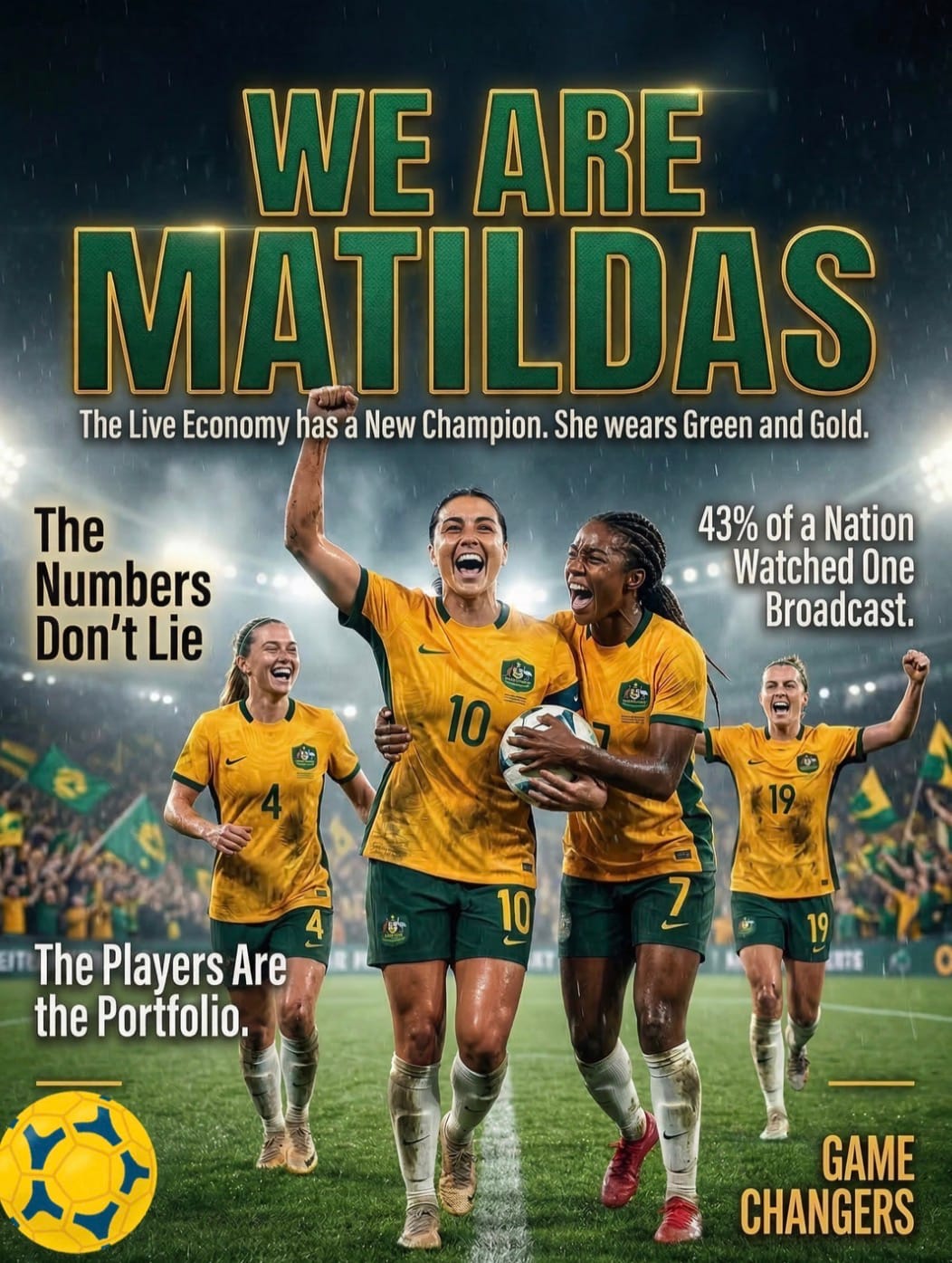
At $2.78 Bn,The Live Economy has a New Champion. She wears Green and Gold.

The Matildas | By Swaroop Banerjee | March 2026.
74,397 in the stadium including me. 11.15 million on television. $2.78 billion in media value. 341% spike in online store subscribers. A jersey that sold out in five minutes. A government that pledged $200 million because a football team filled every seat in the country. A sports capital story, and the Matildas wrote it.
The AFC confirmed that Australia 2026 became the best-attended Women's Asian Cup in history, with total attendance surpassing 350,000. This is enormous. Because even in defeat to Japan, the Matildas proved again that they are no longer just a national team. They are a national sporting franchise.
What the Matildas carry now is bigger than results. They carry the burden and the privilege of filling stadiums, driving broadcast numbers, moving merchandise, attracting partners, and bringing families and children into football for life. Football Australia's own data shows that Australia's seven matches during the 2023 FIFA Women's World Cup attracted 403,136 fans, averaging 57,591 per match and reaching 99.92% of capacity at every venue. During the FIFA Women's World Cup period, Football Australia's online store revenue surpassed the entire prior financial year by 30%.
That is the real story. A women's team built properly, yes it wins games but more than that it expands the sport's economy, widens the audience, creates heroes for children, gives families a reason to show up together, and turns fandom into long term national value.
The Numbers Don't Lie.
Before a single ball was kicked at the 2023 FIFA Women's World Cup, Disney had already chosen their story. Matildas: The World at Our Feet, a six part original documentary series commissioned by Disney+ and released globally in April 2023, gave the world an intimate, behind-the-scenes portrait of Sam Kerr, Mary Fowler, Caitlin Foord, and the squad building toward a home World Cup.
Women's sports globally are projected to earn $2.35 billion in 2025, a 25% increase over the record $1.88 billion produced in 2024. Global revenue nearly doubled from $981 million in 2023 to $1.88 billion in 2024. The entire category didn't cross a billion dollars until last year. This acceleration is structural.
Women's sports revenue grew 4.5 times faster than men's sports between 2022 and 2024. The NFL isn't growing at that rate. The Premier League isn't growing at that rate. The argument that women's sport is a charitable act has always been bizarre. It is now the highest velocity growth asset in the global sports economy.
The NWSL saw its average annual broadcast value increase 40 times after striking new deals with CBS, ESPN, Prime Video, and Scripps Sports. The WNBA's new media deal, beginning in 2026, is worth $200 million annually, more than triple its previous agreement, outpacing the NBA's own renewal rate by 2.6 times. These are signals about where capital flows when it pays attention, not just feel good stats.
As a proud Indian Australian and someone who helps build live economies, I believe the Matildas did not ride this wave but helped create it.
43% of a Nation Watched One Broadcast.
On 16 August 2023, Australia played England in the semi-final of the FIFA Women's World Cup. The match reached 11.15 million Australians on the Seven Network, the most watched television programme in Australia since 2001. That figure represents over 43% of the national population. It does not include the crowds at pubs, live sites, and public screens. Three Sydney stadiums projected the match simultaneously.
Across Seven's full tournament coverage, the Matildas' seven matches generated an aggregate viewership of 24.08 million. The quarter final against France, which Australia won 7-6 on penalties, reached 7.2 million people and was described as a cultural moment comparable to Cathy Freeman's 400 metre gold at the Sydney Olympics. That singular statistic alone is incredible to the story.
The Jersey That Sold Out in Five Minutes. Mackenzie Arnold is a Legend.
Five minutes. That is how long it took for goalkeeper Mackenzie Arnold's purple jersey to sell out following its first online release in February 2024. One goalkeeper. One jersey drop. Five minutes. What other superstar athlete brings in this level of fandom?
Throughout the 2023 World Cup, double the number of Matildas jerseys were sold compared to Socceroos jerseys sold during the Qatar Men's World Cup the prior year. For the first time in Australian football history, a women's team outsold the men's. Not by a fraction but by a factor of two. The ratio of Matildas merchandise sales to Socceroos currently sits at two to one.
Active subscribers to Football Australia's e-commerce store increased by 341% during the tournament. The 2025 Matildas kit, designed in collaboration with Kamilaroi artist Reko Rennie, the first national team collection ever created by a First Nations artist, is itself a cultural product. To me it is a piece of Australian identity you can wear.
The Players Are the Portfolio.
Sam Kerr is the all time leading scorer in Australian football history with 73 international goals. She is the only female footballer ever to win the Golden Boot in three different leagues across three different continents. In 2022, she became the first female footballer to appear on the global cover of EA FIFA, sharing the Ultimate Edition alongside Kylian Mbappé.
Mary Fowler is now considered the most marketable athlete in Australia across all sports, with endorsement deals spanning Weet-Bix, CommBank, L'Oréal Paris, Samsung, Adidas, Rebel Sports, Cupra, and Barbie. Following the 2023 World Cup, she became the second most Googled Australian by Australians. The Daily Telegraph named her the most influential woman in Australian sport. She plays her club football at Manchester City and is only 23 years old.
Then there is Steph Catley and Caitlin Foord at Arsenal, Hayley Raso at Eintracht Frankfurt, Clare Hunt at Tottenham Hotspur, and Winonah Heatley at AS Roma. The Matildas are starters, match-winners, and Champions League participants. These are globally placed assets who return to the green and gold and fill stadiums in Australia.
The home attendance record for a standalone Matildas match now stands at 76,798, set at Stadium Australia in 2024, surpassing even the 2023 World Cup figures. Every professional game the Matildas played post World Cup sold out. Every single one.
The Children's Economy. Let's Go Tillis. Let's Go.
What the Matildas have done is build the most cost-effective audience acquisition machine in Australian sport. And they did it by making every child in the country want to play football.
In 2024, clubs around Australia reported a 34% increase in registrations for female players, more than 25,000 new players in New South Wales alone. Post World Cup, registrations were already up 20% within weeks of the tournament ending.
The Australian government pledged $200 million to improve women's sporting facilities as a direct result of the Matildas' performance. The economic impact of hosting the tournament was $1.32 billion. It unlocked $398 million in federal and state government funding, of which $129 million positively benefited other sports.
A team that fills stadiums drives infrastructure, which drives participation, which drives registration revenue, which builds the next generation of players and fans for twenty years. The Matildas did not need a government mandate to achieve this. I would argue the government simply followed them.
CommBank, whose naming rights deal is estimated at up to $2 million per year, reported that supporting the Matildas helped them achieve globally iconic brand status for the first time in the company's history. They doubled their brand association metrics during the World Cup and sustained that level, equalling what a 25 year cricket sponsorship had built.
SportsPro calculated that the Matildas' media value had built to $2.78 billion through the 2023 tournament.
The Real Capital Thesis.
Women's sports revenue grew from $692 million in 2022 to $1.88 billion in 2024. Fortune 500 brands investing in multiple women's leagues grew their returns six times year on year. WNBA Changemaker partners saw an average return on investment of 286%.
The Matildas sit at the intersection of every one of these forces: broadcast pull, merchandise velocity, grassroots activation, elite European club placement, cultural narrative, and a fandom built on families. Every little girl and boy in a green and gold jersey chanting Let's Go Tillis Let's Go is a twenty year commercial relationship in its first season.
That is the intelligence of capital. The ecosystem around the team that makes the trophy matter.
My sons were sad to see the Matildas lose to Japan in the final but to me, not every final ends with a trophy. Some end by proving the market has already changed.
The Matildas are that proof.
Swaroop Banerjee is a live economy and IP executive with over twenty years building sovereign scale live economies across South Asia, the GCC, and Asia Pacific. He is the author and founder of The Chaos Drop, a global entertainment and sports intelligence platform, and Senior Partner at Hammerhead Global in the UAE.
The Chaos Drop publishes strategic analysis of the global live economy for the decision makers who need to be ahead of it. We follow the money.