$64 Billion for Music. $10.9 Billion for Football. $600 Million Lost Per Day. Q1 2026 in Focus.


The Chaos Drop | By Swaroop Banerjee | April 2026
Q1 2026 was not a quiet quarter, was it? It was a stress test. Geopolitical shock, back to colonialism, a landmark hostile takeover bid, a category of financial product crossing the trillion dollar threshold, a tournament about to rewrite the economics of three sovereign host nations simultaneously, and a region of 700 million people quietly becoming the most contested live entertainment frontier on earth.
Capital however did move. Here is where it went, why it went there, and what it means for the architecture of the global live economy for the rest of this decade.
1. Bill Ackman Bids $64 Billion for UMG. What's Cooking?
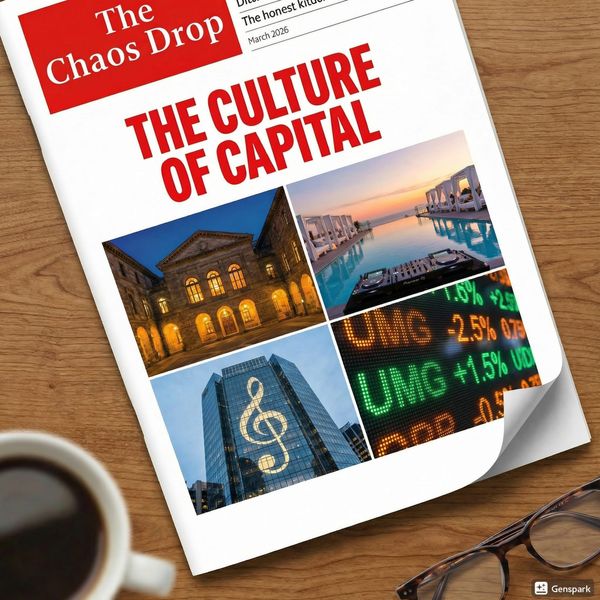
On 7 April 2026, Bill Ackman's Pershing Square Capital Management proposed a $64 billion acquisition of Universal Music Group, intending to move its listing from Amsterdam to the New York Stock Exchange. The cash and stock deal values UMG at €30.4 per share, a 78% premium over its last closing price, with shareholders receiving €9.4 billion in cash as part of the transaction.
You would think it's a tech bet or streaming play, nope. A $64 billion bid for the company that owns the rooms where music lives, the catalogues, the artists, the touring relationships, and critically, a €2.7 billion stake in Spotify that Ackman explicitly cited as underutilised on UMG's balance sheet.
Ackman's argument is my argument made at institutional scale. Even as the music industry flourishes, UMG's share price has lagged, and he is pledging to fix that by moving the listing to New York, opening it to index fund ownership and unlocking the full capital value of the world's most powerful music IP. Genius move?
The signal is not the bid. The signal is the thesis behind it. The world's most visible activist investor just told every sovereign fund and institutional allocator that music IP is structurally underpriced. H0w do you think a conversation this size will remain in Amsterdam.
2. FIFA 2026 Will Generate $10.9 Billion. The Ad Market Is Already Losing the Plot.
The 2026 FIFA World Cup is projected to generate revenues exceeding $10.9 billion, with broadcast rights surpassing $4.2 billion and sponsorship revenues exceeding $2.8 billion, both record figures. The tournament is expected to generate a $40.9 billion boost to global GDP, with 185,000 jobs producing $10.2 billion in income across the three host nations.
So what could be inconvinient here? Despite record audiences and rising rights fees, WARC Media's latest analysis shows the World Cup's measurable contribution to ad spend growth is weakening, forecast to deliver a $10.5 billion uplift to global advertising, down from $12.6 billion in 2018, even as the tournament expanded from 64 to 104 matches.
The ad market is fragmenting faster than FIFA's commercial model can adapt. Premium pricing for broadcast and sponsorship inventory is crowding out regular advertisers, meaning much of the observed revenue growth reflects redistribution rather than new spending.
What is not fragmenting is live gate and experiential. Live Nation and Ticketmaster are the primary infrastructure backbone for ticketing and live event management across 16 host cities, positioned to benefit from millions of transactions throughout the tournament. The money is moving from passive broadcast impressions to active live participation. To me this is a structural shift at scale. Intended or otherwise.
3. The Middle East Lost $600 Million a Day. Will the Ceasefire change that equation?
This is the capital story that is unfolding in real time as this article goes to press.
The regional conflict between the US, Israel, and Iran was costing the Middle East travel and tourism industry €515 million a day, based on the WTTC's 2026 pre-conflict forecast of €178 billion in international visitor spending across the region this year. Regional forecasts cited by financial and tourism consultancies estimate that Middle Eastern destinations could forfeit between $34 billion and $56 billion in visitor spending in 2026 if hostilities continue.
The ceasefire brokered on 7 April changes the calculus, hopefully. Dubai Executive Council has approved Dh1 billion in short-term economic incentives from April to September 2026, including a three-month 100% postponement of Tourism Dirham and hotel sales fees, to support the hospitality sector's recovery. As of 8 April, Dubai International Airport is operating at roughly 53% capacity, with Emirates running over 150 daily departures, its highest since the conflict began.
The forward position? Industry leaders are pointing to cautious optimism, but most agree a full rebound will take time, with companies prioritising continuity and long term value over short term speculation. The live entertainment calendar Riyadh Season, Abu Dhabi's cultural programme, Dubai's events infrastructure was built on what I would call a pre conflict trajectory of double digit visitor growth. That trajectory is now being rebuilt from a lower base with government capital underwriting the recovery.
For anyone with sovereign mandate exposure in the GCC, this is the most important real time data point in the global live economy right now. The money will come back, no question. The sequencing is what I would watch closely.
4. Live Nation Posted $25.2 Billion in Revenue. Then Said It Was Just Getting Started.
We had covered earlier that Live Nation reported full year 2025 revenue of $25.2 billion, up 9%, with operating income of $1.3 billion, up 52%, and adjusted operating income of $2.4 billion, up 10%. Concert AOI reached a record $687 million, up 30%, with best-ever margins of 3.3%. Fan attendance increased 5% to 159 million across more than 50,000 events.
For capital allocators out there, you must look at the data with a trained eye. Live Nation invested nearly $15 billion in artists and shows in 2025, reinforcing its position as the leading financial supporter of artists globally. And for 2026, the company plans to open at least 20 large venues globally, creating capacity for approximately seven million incremental fans on a run-rate basis, with average investment returns of 20% or above.
20% IRR on venue infrastructure. In a world where sovereign bonds yield 4% and commercial real estate is being repriced downward, live entertainment venues are delivering institutional grade returns with cultural upside attached. That is the asset class argument made in a single line item from a public company's earnings report.
5. Southeast Asia Just Became the Most Contested Live Entertainment Frontier on Earth.
The ASEAN region's music industry currently represents only 1.7% of the global market. That single statistic is either a problem or an opportunity, depending on where you are sitting. I would think every major promoter in the world decides it is an opportunity.
Tomorrowland has confirmed its first ever full scale Southeast Asian edition for December 2026 in Chonburi, Thailand, with tickets selling out in under an hour. Rolling Loud, Electronic Daisy Carnival, Creamfields, and talks of Lollapalooza's expansion into the region have all signalled that Southeast Asia is rapidly becoming a go to destination for live music experiences at global scale.
The structural case is compelling. Studies from the Asian Development Bank and McKinsey project that over 65% of the region's population will be middle class by 2030, empowering millions of younger consumers who prioritise experiences over material goods. Indonesia has established a tourism fund worth $86 million specifically to attract international artists. Thailand's live music market is projected to reach $176 million in profits, supported by the government's IGNITE Thailand initiative promoting the country's festival culture.
The infrastructure gap is quite real, which is a struggle is most of these economies. Vietnam lacks arenas that can hold crowds of 30,000 to 50,000 people, keeping it on the sidelines of the biggest concerts but that gap is precisely where the capital opportunity lives. The promoter who builds the room before the demand peaks owns the market. Learn from Live Nation, that structure is in play IRL RN.
6. Prediction Markets Just Crossed $44 Billion in Volume. Bank of America Is Calling It a $1.1 Trillion Market.
This is the category that most live economy executives are watching from a distance.
Total notional trading volume in prediction markets reached over $44 billion in 2025, with combined open interest across major platforms growing from $3.3 billion to nearly $13 billion. Kalshi, the market leader, reached a $11 billion valuation following a Series E funding round, generating $263.5 million in fee revenue in 2025, most of it from sports.
Bank of America estimates the potential market for US sports-related event contracts at roughly $1.1 trillion in annual volume. Assuming an average fee of approximately 1%, that translates to around $10 billion in annualised revenue for event betting companies.
Mass market platforms including DraftKings, FanDuel, and Robinhood rolled out regulated prediction products directly ahead of the 2026 FIFA World Cup, treating the tournament as the single largest activation moment for the category. Robinhood's customers alone traded 2.5 billion prediction market contracts in October 2025, primarily on sports, making it the company's fastest growing business line.
To me this is a fan monetisation story. The moment a spectator can trade a contract on live match outcomes in real time, the economic relationship between the event, the broadcaster, and the fan changes permanently.
7. The Live Economy Itself Posted Its Best Year in History.
Across every category; concerts, sports, festivals, experiential. The global live economy outperformed its own projections in 2025 and entered 2026 with forward indicators at record levels.
Ticketmaster ended Q1 2025 with record deferred revenue of $270 million, up 13%, indicating a strong pipeline of demand already committed for the year ahead. Live Nation's stadium show pipeline for 2026 is up 60% on the prior year. The live economy is not recovering from a disruption. It is compounding from a record base.
The macro validation; women's sports alone are projected to earn $2.35 billion globally in 2025, a 25% increase over 2024, which itself beat original forecasts by 47%. Women's sports revenue grew 4.5 times faster than men's sports between 2022 and 2024. When the fastest growing segment of the fastest growing entertainment category is still dramatically underpriced relative to its male equivalent, the overall market has further to run than most models currently show.
The Capital Rotation Table
From where I sit following capital, when it moves, where it moves, why it moves. The view is something like this.
| From | To |
|---|---|
| OTT / Streaming (yield compression) | Live Experiences (gate + ancillary growth) |
| Film / TV IP (structural decline) | Touring & Events (recurring demand, 20% IRRs) |
| Static Sponsorship (fragmenting) | Interactive Fan Engagement (prediction, participation) |
| Broadcast Advertising (diminishing returns) | Experiential Activation (measurable ROI) |
| Gaming in isolation | Sports × Gaming Hybrid (cross-category monetisation) |
| Single-market entertainment bets | Multi-sovereign live infrastructure (Southeast Asia, GCC recovery) |
| Passive music streaming equity | Music IP as hard asset (Ackman thesis: UMG at $64 billion) |
My thesis has not changed since the day we launched TCD. I just have the evidence in plain sight.
Capital follows attention, the attention looks to be live. The room that fills, the stadium, the festival field, the arena is the highest returning asset in the experience economy when it is built and operated with sovereign grade discipline and backed with sovereign grade capital.
Q1 2026 proved it across seven separate data points, in seven different geographies, across every sub category of the live economy.
The money knows where it is going. The only question is whether the decision makers in the room are reading the same signals or still waiting for a cleaner entry point that is not coming. The truth in following the money.
Swaroop Banerjee is a live economy and IP executive with over twenty years building sovereign-scale live economies across South Asia, the GCC, and Asia Pacific. He is the author and founder of The Chaos Drop, a global entertainment and sports intelligence platform, and Senior Partner at Hammerhead Global in the UAE.
The Chaos Drop publishes strategic analysis of the global live economy for the decision makers who need to be ahead of it. We follow the money.